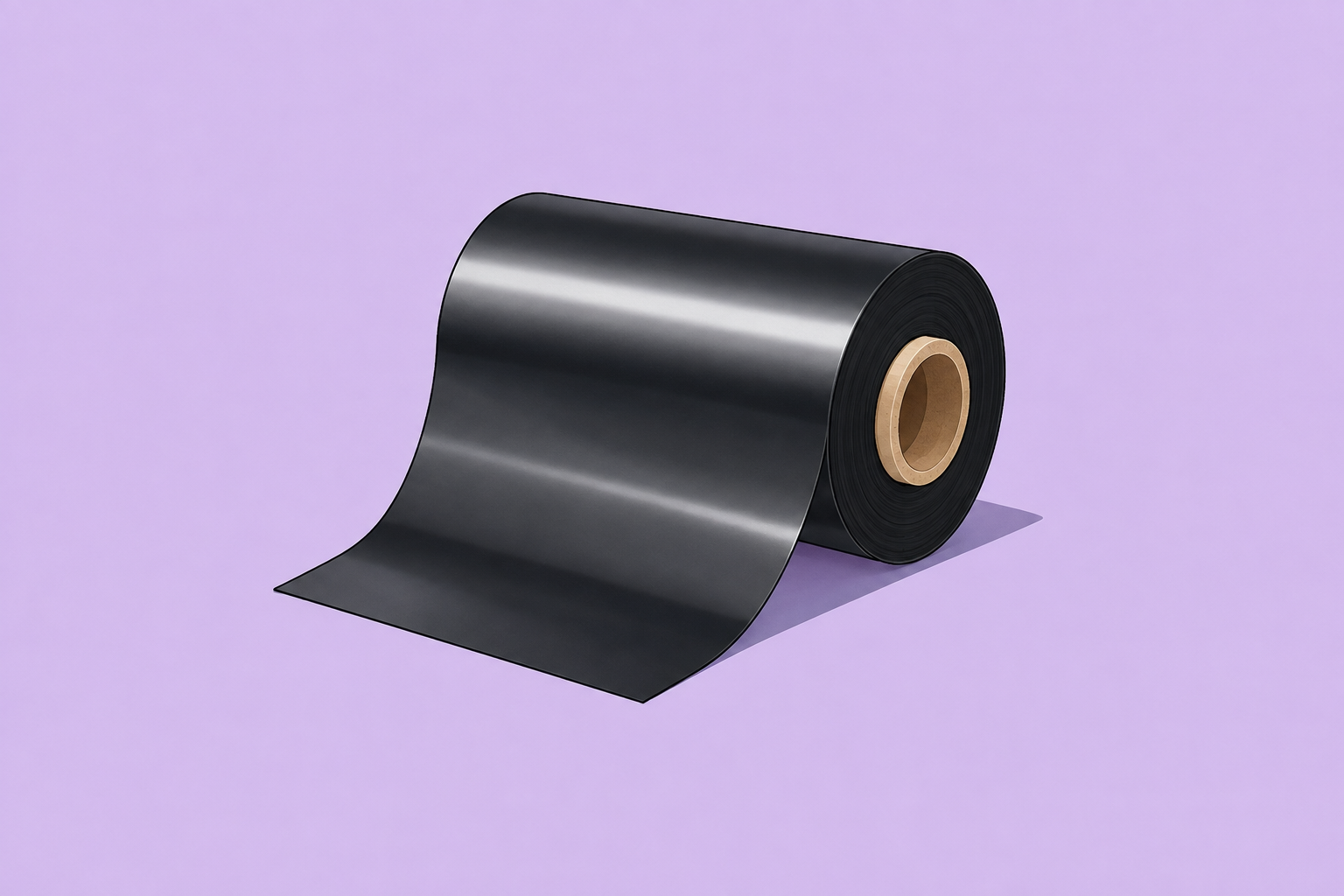
When you print labels with a thermal transfer label printer, you need a thermal transfer ribbon in addition to the labels. These ribbons are generally divided into three types: wax, wax/resin and resin.
Which type you need mainly depends on the material of the label and the conditions the print will be exposed to. A wax ribbon, for example, is very suitable for paper labels, while wax/resin or resin is usually used for plastic labels.
What is a thermal transfer ribbon?
A thermal transfer ribbon is a foil with an ink layer that is transferred onto the label using heat. The print head of the label printer heats the ribbon at exactly the spots where text, barcodes or images need to be printed.
Unlike direct thermal labels, the label itself therefore does not contain a heat-sensitive layer that turns black. The actual print comes from the ribbon.
The composition of this ink layer largely determines how wear-resistant and durable the print becomes. A distinction is made between:
- wax ribbons;
- wax/resin ribbons;
- resin ribbons.
What is a wax ribbon?
A wax ribbon mainly consists of an ink layer based on wax. Wax has a relatively low melting point. As a result, the print head needs relatively little heat to transfer the ink onto the label.
Wax ribbons are mainly used for paper thermal transfer labels. They are suitable for applications where the print is not subjected to heavy strain, such as product labels, warehouse labels, shipping labels and general identification labels.
An important advantage of wax ribbons is the favourable price. In addition, they can be used at relatively low print temperatures, which puts less strain on the print head.
The downside is that a wax print is less resistant to scratches, friction, moisture and chemicals. If you rub firmly across the print, it can get damaged.
For normal paper labels, wax is nevertheless usually the most logical choice.
What is a wax/resin ribbon?
A wax/resin ribbon contains a combination of wax and resin. This creates a print that is stronger and more wear-resistant than with a standard wax ribbon.
Wax/resin is widely used on coated paper labels and plastic labels. The exact suitability depends on the surface and coating of the label material used.
The print is more resistant to scratches and friction and generally also has better resistance to moisture, oil and certain chemicals.
Wax/resin therefore forms a middle ground between wax and full resin. It is more durable than wax, but usually cheaper and easier to print than a full resin ribbon.
For applications where labels are touched regularly or exposed to somewhat harsher conditions, wax/resin is often a good choice.
What is a resin ribbon?
A resin ribbon has an ink layer that mainly consists of resin. More heat is needed to transfer this ink than with wax or wax/resin.
Resin ribbons are mainly used on plastic labels, for example labels made of polypropylene (PP), polyethylene (PE) or polyester (PET).
After printing, a very strong print is created. Depending on the combination of ribbon and label material, the print can be highly resistant to, among other things, water, oil, alcohol, cleaning agents, scratches and various chemicals.
Resin is therefore often used for industrial labels, chemical labels, laboratory labels, product identification and other applications where the print must remain clearly legible for a longer period.
A resin ribbon is generally more expensive than wax or wax/resin. It is therefore not automatically the best choice for every application.
Comparing wax, wax/resin and resin
| Ribbon type | Most commonly used for | Wear resistance | Resistance to moisture and chemicals | Price |
|---|---|---|---|---|
| Wax | Paper labels | Low to medium | Low | Low |
| Wax/resin | Coated paper and various plastics | Medium to high | Medium | Medium |
| Resin | PP, PE, PET and other plastics | High to very high | High | High |
Which ribbon do you need?
The right thermal transfer ribbon is primarily determined by the material of your labels.
For standard paper thermal transfer labels, a wax ribbon is usually sufficient. For smooth or coated paper, wax/resin can be a better choice.
For plastic labels, wax/resin or resin is generally used. When maximum wear resistance or chemical resistance is important, a resin ribbon is the most obvious choice.
As a general guideline, you can therefore use:
TT paper → wax
TT plastic for general use → wax/resin
TT plastic for heavy-duty or industrial applications → resin
This classification is not an absolute rule, however. The surface and coating of the label also play an important role. A more expensive resin ribbon therefore does not automatically produce a better print than wax. Ribbon and label material need to be well matched to each other.
How do you determine the right width of a thermal transfer ribbon?
In addition to the right material, you also need to choose the right ribbon width.
You should not look solely at the width of the label. In principle, the ribbon must cover the entire label web, including the backing paper on which the labels sit.
As a rule of thumb:
Choose a ribbon that is at least as wide as the total label web, and preferably a few millimetres wider.
For example, if you have a 50 mm wide label and the backing paper is about 53 mm wide, a ribbon of around 55 mm is a suitable choice.
For labels about 100 mm wide, a 105 or 110 mm ribbon is often used. For 102 mm wide labels, a 110 mm ribbon is, for instance, a commonly used size.
Why shouldn't a ribbon be too narrow?
A ribbon that is too narrow can cause part of the print head to run directly over the label material or backing paper.
This can cause unnecessary wear to the print head. In addition, a ribbon that is too narrow can cause problems when printing close to the edge of the label.
It is therefore generally better to choose a ribbon a few millimetres wider than the label web.
Can a thermal transfer ribbon be too wide?
A ribbon that is significantly wider than the label will simply work technically in many printers. The main downside is the extra material consumption.
For example, if you use a 110 mm ribbon for labels that are only 60 mm wide, a large part of the ribbon goes unused. With large label quantities, this can make a significant difference in consumption and cost.
Therefore, preferably choose the smallest ribbon width that sufficiently covers the entire label web.
Also always check which minimum and maximum ribbon width your label printer supports. Many common 4-inch thermal transfer printers support ribbons up to about 110 mm wide.
What ribbon length do you need?
In addition to the width, the length of the ribbon must also suit your label printer. You cannot simply use any ribbon with the correct width. The maximum ribbon length is determined by the construction of the printer and the space available for the ribbon roll.
Compact desktop label printers generally use shorter ribbons, while larger professional and industrial printers can handle considerably longer ribbons. Common ribbon lengths are, for example, 74, 110, 300 and 450 metres. Printers and ribbons with other lengths also exist.
You will normally find the required ribbon length in the technical specifications of your label printer. Do not use a longer ribbon than your printer supports, even if the width and type of ribbon are correct.
What is the advantage of a longer ribbon?
If your printer supports multiple ribbon lengths, a longer ribbon is usually practical for higher print volumes. You then need to replace the ribbon less often.
A 450-metre ribbon, for example, needs to be changed considerably less often than a 110-metre ribbon. That saves time when large numbers of labels are printed every day.
A longer ribbon is, however, also physically larger. A desktop printer designed for ribbons of, say, 74 or 110 metres usually does not have enough space to fit a 300 or 450-metre ribbon.
Also pay attention to the core diameter of the ribbon
The length of a ribbon is often linked to the diameter of the core on which the ribbon is wound. Shorter ribbons for desktop printers are usually supplied on a smaller core, while longer ribbons for industrial printers often have a larger core.
The correct ribbon length alone is therefore not enough. The core must also fit the ribbon holder of your printer.
When purchasing, therefore always check:
- the length of the ribbon;
- the diameter of the core;
- the maximum outer diameter that fits in the printer.
How many labels can you print with one ribbon?
The length of the ribbon determines roughly how many labels you can print before the ribbon needs to be replaced. During thermal transfer printing, the ribbon moves along with the label. Roughly the same length of ribbon is therefore used per label as the length of the label including the gap between two labels.
Suppose you use labels of 100 x 150 mm with a gap of 3 mm between each label. Approximately 153 mm of ribbon is then used per label.
With a 300-metre ribbon, you can theoretically print approximately the following number of labels:
300,000 mm ÷ 153 mm = approximately 1,960 labels
This is a theoretical calculation. In practice, a small amount of ribbon is always lost when loading and removing the ribbon, calibrating the printer and changing labels or ribbons.
Does the ribbon need to be as long as the label roll?
No. The length of the ribbon does not need to match the length of the roll of labels.
A 110-metre ribbon can, for example, print several rolls of labels if each label roll contains less than 110 metres of material. Conversely, a label roll can also be longer than the ribbon, meaning you have to fit a new ribbon partway through the same roll of labels.
With frequent use, it can be practical to match the ribbon length to the number of labels per roll. This way you can avoid having to replace the ribbon shortly after replacing a label roll, or vice versa.
Calculating ribbon length based on your labels
If you want to determine in advance roughly how many labels you can print with a ribbon, you can use a simple calculation for this:
Ribbon length in millimetres ÷ (label length + gap) = number of labels
A 450-metre ribbon, for example, is 450,000 mm long. For labels 50 mm long with a 3 mm gap, the theoretical consumption is 53 mm per label:
450,000 mm ÷ 53 mm = approximately 8,490 labels
Also take some practical material loss into account in this calculation.
The winding direction of the ribbon must also match
In addition to type, width and length, the winding direction of the ribbon must also match your printer.
Ribbons can be supplied as ink inside or ink outside. With ink inside, the ink layer is on the inside of the rolled-up foil. With ink outside, it is on the outside.
Some printers only support one of the two variants, while other printers can work with both windings. Therefore always check your printer's specifications before ordering a ribbon.
What should you pay attention to when choosing a ribbon?
For a suitable thermal transfer ribbon, you ultimately need to check several properties:
- Type: wax, wax/resin or resin;
- Width: at least wide enough for the entire label web;
- Length: suitable for the maximum ribbon length of your printer;
- Core: the correct core diameter for your printer;
- Winding: ink inside or ink outside;
- Label material: the ribbon must be suitable for the paper or plastic used.
Conclusion
For a good thermal transfer print, the label, the ribbon and the label printer need to be matched to each other.
For normal paper labels, wax is usually the most affordable and suitable choice. Wax/resin offers extra wear resistance and is used on coated paper and various plastic materials. Resin is mainly used when plastic labels need a particularly durable and resistant print.
Then choose a ribbon that covers at least the full width of the label web. Also check which ribbon length, core diameter and winding direction your printer supports. The ribbon length also determines roughly how many labels you can print before the ribbon needs to be replaced.
By matching both the type, width and length of the ribbon to your labels and label printer, you avoid unnecessary material consumption and get a reliable, durable print.